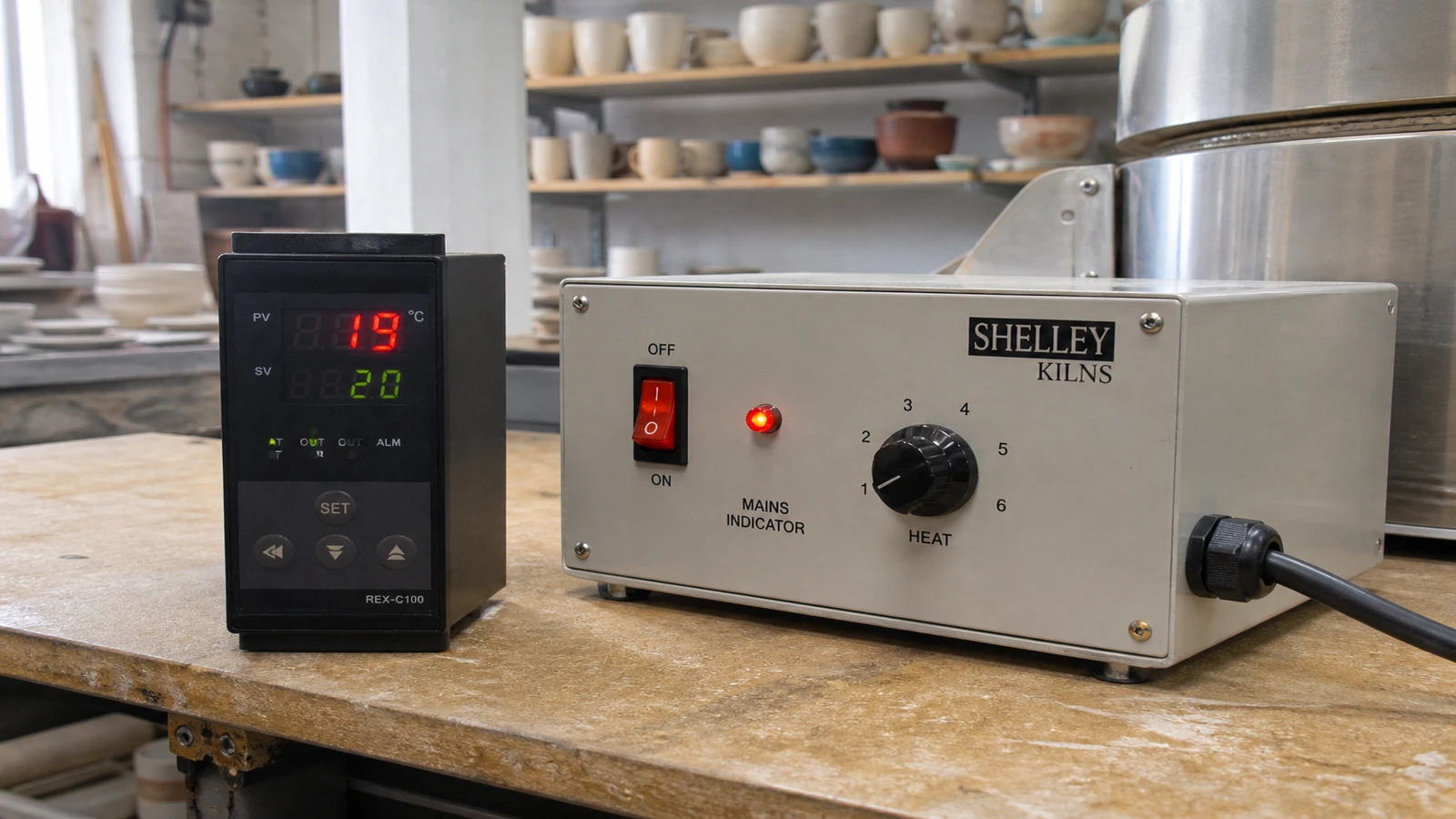
Upgrade old kiln with PID controller UK: single-setpoint panel path
Upgrade old kiln with PID controller UK is the search when a pottery shed still runs on High, Medium, and Low switches and the owner wants a number on the dial. A panel PID can hold one setpoint and switch heater power more intelligently than a dumb dial. It is not a full ramp/soak kiln programmer, not BS 7671 electrical design, and not a substitute for a qualified installer when mains rewiring is required. This site lists the XMT7100 panel PID at £108.25 inc. VAT for builders who need a slim 45 × 22 mm head.
When old kiln switches push owners toward a panel PID
Aging kilns drift, contacts weld, and operators guess “Medium plus five minutes”. A PID lets you set 220 °C or 600 °C and hold with feedback instead of eyeballing glow colour. UK ceramics forums and knife-tempering hobbyists describe exactly that upgrade path. The win is repeatability for a single target temperature, not automatic firing schedules with multiple ramps.
Single-setpoint hold versus kiln programmer
Ramp and soak programmes — slow climb, hold, cool — need a programmer or controller firmware built for multiple segments. The XMT7100 on this site is marketed as a PID temperature controller with auto-tune for one setpoint loop. Treat it as hold-then-manual-off or hold-until-alarm, not as a replacement for a multi-segment kiln programmer unless your exact manual documents those features and you verify on the unit.
Size comparisons for panel heads appear in the Rex-C100 vs XMT7100 article when you are also weighing square kits.
Relay to contactor versus SSR to element
Most kiln elements cycle fast enough that builders choose SSR pulse output into an external SSR and heatsink. Published XMT7100 output options include 12V DC SSR pulse or 3A relay. Relay output suits a contactor coil if your kiln already uses a contactor chain. The SSR vs relay output guide maps those paths without publishing a fuse chart.
- Size external switching for element amperage, not controller brochure photos.
- Sensor type is commonly K-type in kiln work; Pt100 is listed on the product page if your probe matches.
- Controller-only ordering: verify box contents on the detail page.
Sensor choice without ramp/soak features
Pick a probe that matches the published sensor list and your kiln’s thermocouple location. A PID cannot fix a probe in the wrong zone. Auto-tune learns the loop for the installed heater and mass; it does not promise overshoot-free marketing language or invent accuracy percentages for your firing curve.
Limits: not BS 7671 advice, not a programmer substitute
Kiln mains work, isolation, and earthing stay with qualified practice and local rules. This article does not provide Part P answers, fused spur schedules, or earth bonding diagrams. If the upgrade needs new feed wiring, hire competence. If the upgrade needs eight-segment firing profiles, buy a programmer class product — not a single-setpoint panel head alone.
Review the XMT7100 detail page as the panel head
If a slim 45 × 22 mm panel PID matches your enclosure and you accept single-setpoint control, review output type, sensor list, and price on the XMT7100 detail page. Measure cutout before you order.
Will this PID run a full pottery firing schedule?
Not as a multi-ramp programmer substitute. It holds a setpoint you set.
Can I wire the kiln myself from this article?
No. Output choice is explained here; mains design is not.
Does the listing include kiln element and SSR?
Only if the live page names them. Expect controller-only by default.