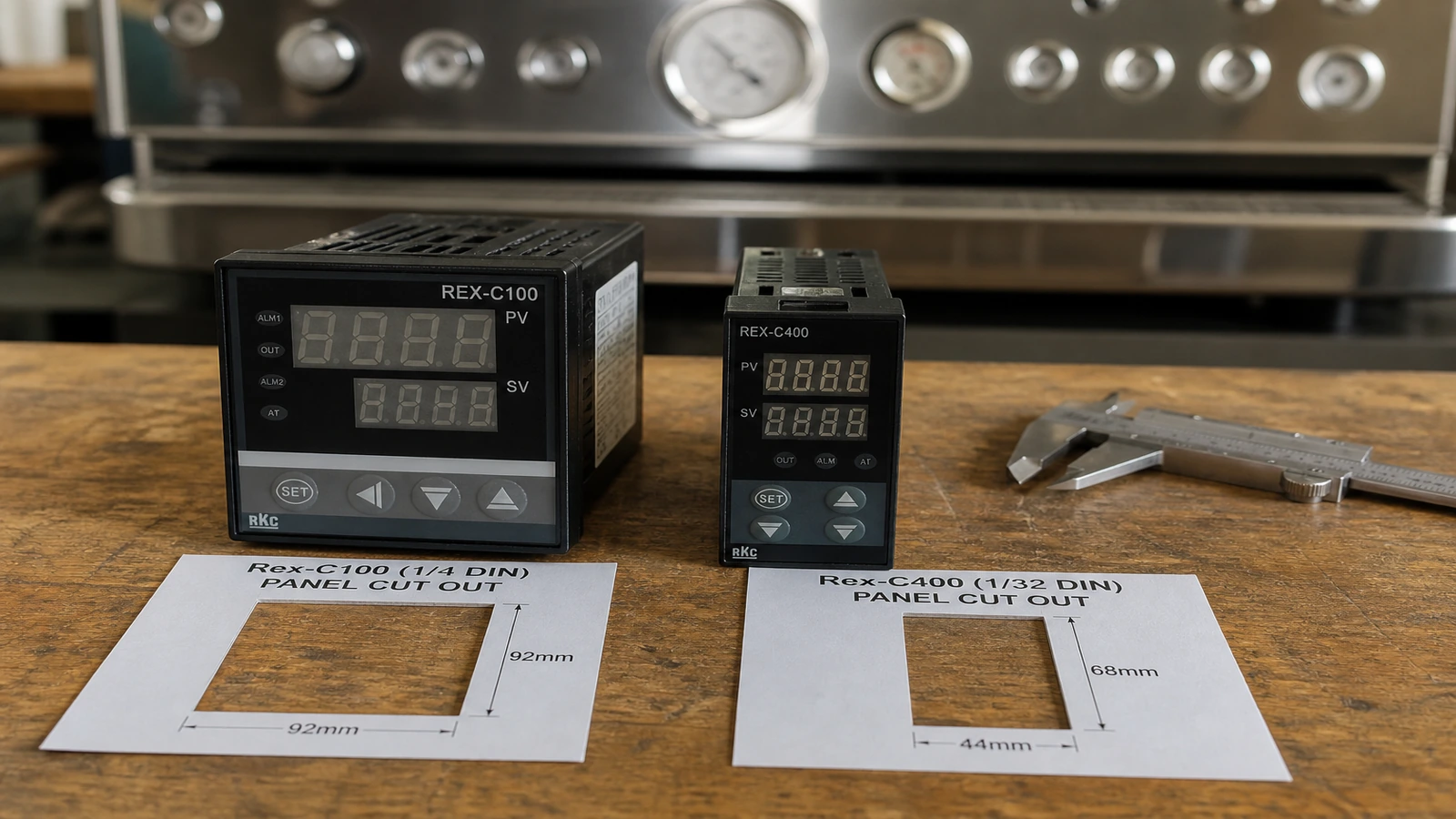
Rex-C100 vs XMT7100 PID controller UK: square kit vs slim 45×22 panel head
Rex-C100 vs XMT7100 PID controller UK is a panel-size and packaging question before it is a brand question. UK espresso DIYers, small kiln owners, and heat-press retrofitters often start with a cheap square Rex-C100 kit from a marketplace because it bundles SSR, probe, and a dual-line display. The XMT7100 is the slim 1/32 DIN head with a 45 × 22 mm cutout that fits tight machine fascias. This site sells the XMT7100 panel PID at £108.25 inc. VAT — not a Rex kit, and not a guarantee that either family solves ramp/soak programming or food-grade compliance.
Why UK builders compare these two model families
Espresso Hackers and UK coffee forums name both models in the same breath: Rex for cost and easy setpoint arrows, XMT7100 for form factor in a Silvia or Gaggia fascia. Kiln and heat-press owners add the same trade-off when a square head would block a sight glass or stick out of a thin door. The comparison intent is physical fit and control style, not a lab shoot-out with invented accuracy tables.
Cutout and face size on real panels
Rex-C100 catalogue language commonly cites a 48 × 48 mm bezel with roughly 45 × 45 mm cutout and dual PV/SV LED rows. The XMT7100 published on this site uses a 48 × 24 mm bezel and 45 × 22 mm cutout. On a crowded panel that difference is not cosmetic — it decides whether you need a new fascia plate.
| Panel question | Typical Rex-C100 kit path | XMT7100 on this site |
|---|---|---|
| Cutout language | Square ~45 × 45 mm in common UK kit listings | Published 45 × 22 mm cutout, 48 × 24 mm bezel |
| Display layout | Often dual row PV and SV on square face | Dual-line LED on slim head per product page |
| What this article does not invent | Competitor overshoot or accuracy scores | Performance percentages beyond published specs |
Output packaging: kit bundles versus slim head
Amazon UK Rex kits often ship controller, 40A SSR, K-type probe, and heatsink in one box — convenient for a first brew kettle or test oven. The XMT7100 listing on this site is typically controller-only unless the live page names a bundle. You still choose SSR pulse drive with external relay or internal 3A relay output per the published spec table. Match that to your heater path before you assume either model “includes SSR”.
What neither listing should prove for you
Do not treat either family as CE/UKCA proof, BS 7671 design advice, food-grade certification, ramp/soak kiln programming, or overshoot-free performance unless a specific document on your exact SKU says so. Marketplace star counts and forum anecdotes are not specifications. This article will not quote fake review totals or invent ±0.5% accuracy marketing.
When the slim XMT7100 is the cleaner retrofit
Choose the XMT7100 when the panel opening is already slim, when a square Rex would foul a handle or window, or when you already own SSR and probe parts and only need the head. Kiln owners weighing a single-setpoint hold should read the upgrade old kiln with PID guide for limits before they buy any panel PID.
If the slim head is the cleaner path, compare live price and output type on the XMT7100 detail page. If you want the cheapest square kit with everything in one parcel, a Rex marketplace bundle may still win — this site is not selling that kit.
Is the XMT7100 always better than Rex-C100?
No. It is slimmer and listed here at £108.25 inc. VAT. Rex kits can be cheaper and more bundled.
Can I drop an XMT7100 into a Rex square hole?
Usually not without a new plate. Cutouts differ.
Does either model replace a kiln programmer?
No. Both are single-setpoint panel PIDs, not ramp/soak programmers.